Contents
- Biblical Fantasy and Its Related Genres
- What is Biblical Fantasy?
- Prerequisites for Biblical Fantasy
- The Relationship Between the Bible and Biblical Fantasy
- Why Do We Need Biblical Fantasy?
- A Comparative Overview of Related Genres and Their Relation to Fantanicle
- Fantanicle: A Distinct Literary-Genre Fusion of Classic and Fantasy
- Sister site
Biblical Fantasy and Its Related Genres
This series offers a general overview of the following themes:
- Basic knowledge about the Bible
- How to handle and approach the Bible
- What is Biblical Fantasy?
- Facing errors and misconceptions
In this article, we will delve into the genre of Biblical Fantasy.
By clarifying its definition and comparing it with adjacent genres, we hope you will discover your own path and purpose in engaging with Biblical Fantasy.
What is Biblical Fantasy?
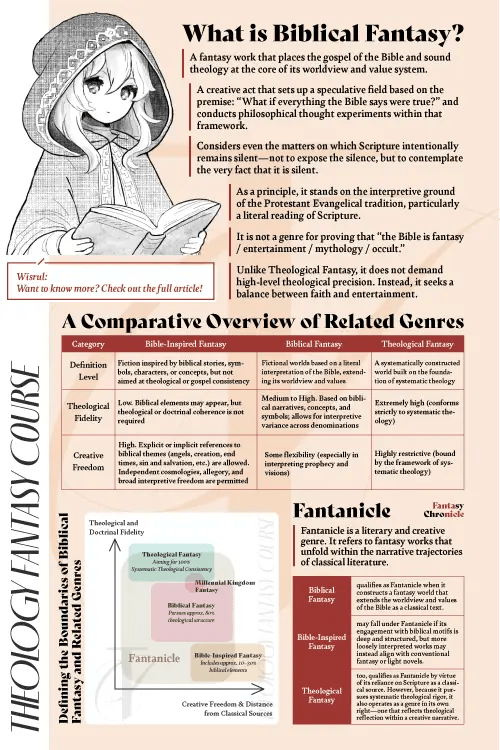
Biblical Fantasy is a creative genre that treats the Bible as sacred Scripture and divine revelation, wholly embracing its worldview and values. It explores humanity, life perspectives, culture, customs, natural environments, and economic systems as they would exist along the narrative trajectory of the Bible.
It is a “speculative field for imagining the future and human nature that emerge from the worldview and values proclaimed in Scripture.”
Works in this genre aim to apply—without alteration—the divine revelation, gospel, doctrine, and worldview presented in the Bible to a fictional world, and to develop them as narrative.
Rather than merely referencing religious motifs, Biblical Fantasy is founded on an attitude of creative expansion that acknowledges the Bible as sacred and receives its literal content in faith.
This sets it apart from conventional “Bible-inspired” fantasy that simply borrows Christian motifs, and instead seeks to establish a form of fantasy born from within the faith itself.
Moreover, Biblical Fantasy encompasses the subgenre of Millennial Kingdom Fantasy.
At a higher conceptual level, it falls under the broader umbrella of Theological Fantasy.
Wry Wonders Lexicon Biblical Fantasy (Japanese)
https://wrywonders.com/codex/lexicon/lexicon-biblical-fantasy/
Prerequisites for Biblical Fantasy
- A fantasy work that places the gospel of the Bible and sound theology at the core of its worldview and value system.
- A creative act that sets up a speculative field based on the premise: “What if everything the Bible says were true?” and conducts philosophical thought experiments within that framework.
- Considers even the matters on which Scripture intentionally remains silent—not to expose the silence, but to contemplate the very fact that it is silent.
- As a principle, it stands on the interpretive ground of the Protestant Evangelical tradition, particularly a literal reading of Scripture.
- It is not a genre for proving that “the Bible is fantasy / entertainment / mythology / occult.”
- Unlike Theological Fantasy, it does not demand high-level theological precision. Instead, it seeks a balance between faith and entertainment.
The Relationship Between the Bible and Biblical Fantasy
It’s like the relationship between soccer and the rules of soccer.
If you pick up the ball and run with it, it’s no longer soccer.
In other words, when you abandon the principles that define soccer, the game itself ceases to exist.
Players and coaches exercise their full creativity within the rules of soccer to craft the most exciting game possible.
While one cannot change a rule like “offside,” one is free to devise a new tactic like the “offside trap.”
To invent tactics, one needs deep understanding and passion for the game. Tactics make the game more engaging, complex, and profound. Spectators enjoy the evolving sophistication, and not only the game itself but even the act of watching becomes a culture of its own. From that culture, various forms of creative expression emerge.
The same applies to creators of Biblical Fantasy.
If they disregard the principles and theology of the Bible, their work becomes just another fictional endeavor.
Biblical Fantasy does not alter Scripture or the gospel, but can produce stories that surprise even pastors and theologians with a “I never thought of it that way!” reaction—and therein lies its appeal.
It is possible not only to create and enjoy Biblical Fantasy, but also to cultivate a culture surrounding its reading and exploration.
Why Do We Need Biblical Fantasy?
This question can also be phrased as follows:
Why is the creation and dissemination of the genre of Biblical Fantasy important for—
- The Christian Church
- Believers
- Writers and readers, including non-believers?
① Significance for the Christian Church
Modern people gather information from the internet.
The information structure of cyberspace—particularly Google Search—has become one version of “reality.”
As of May 2025, there was no clear definition of “Biblical Fantasy(聖書ファンタジー)” in search results. Instead, trivia books within subcultural genres appeared at the top of the rankings.
A person encountering this would likely come away with the impression that:
“The Bible can be read in an occult or subcultural light, and on that basis, a publishing industry and even an economic system have developed.”
But from the standpoint of a Christian, the Bible is the inerrant Word of God—not fantasy, mythology, or occult literature.
Even when the medium is the internet, the desire remains the same:
that people would encounter Jesus Christ through the proclamation of the gospel.
By establishing a theologically sound, gospel-centered definition of “Biblical Fantasy” and having the Church take the lead in preserving and stewarding that definition, we can:
- Prevent non-believers from defining and popularizing the term in non-biblical ways.
- Guard against intentional semantic distortion by heretical movements.
(Note: As of now, search results for “聖書ファンタジー:Biblical Fantasy” have been improved to reflect Wry Wonders’ evangelical and theological definition.)
② Significance for Believers: Establishing New Forms of Devotion
Christians are a minority in Japan.
Even though Christianity may be a majority religion globally, the fact that it is a minority domestically creates tension in how biblical culture is positioned within society.
Still, passionate believers continue to emerge.
Many grow in their desire to devote themselves to Christ—but adequate models and methods for such devotion are lacking.
Even if one acquires deep biblical and theological knowledge, there are often no viable career paths outside of becoming a theologian or pastor.
For women in particular, theological reasons can make leadership roles in the church even harder to attain.
If a growing number of high-quality Biblical Fantasy works are published, adapted, and recognized, a faith-based creative economy can begin to emerge.
③ Significance for Writers and Readers
In today’s world—especially in Japan—it is difficult to feel the reality of the biblical world.
Specifically, there is limited access to the cultural context of ancient Israel, or to experiential understanding of what “believers see” in faith.
Through the power of fantasy, storytelling, and character design, one can present the Bible’s structure, context, and values from many perspectives—offering readers the opportunity to experience them vicariously.
Even non-believing writers can come to encounter the depth of Scripture through the process of creating within this genre.
In the context of a story, readers are often more willing to temporarily suspend everyday logic or social norms and accept the internal rules of the narrative.
Even in a fictional world, one can still encounter the inerrancy and completeness of the Bible—and ultimately, the glory of Christ and God.
Rather than aiming for immediate conversion, a work succeeds as Biblical Fantasy if it awakens curiosity toward the Creator.
For believers, faith-grounded stories offer spiritual reassurance.
Through fictional characters, readers can deepen theological reflection and find encouragement.
Once the genre and its methods are better established, works will increasingly be able to harmonize spiritual depth with entertainment and artistic quality.
This will ease the burden of having few spiritually safe content options and allow Christians to enjoy entertainment without turning to sexually explicit or excessively violent mainstream media.
A Comparative Overview of Related Genres and Their Relation to Fantanicle
Biblical Fantasy is connected to two adjacent genres.
It encompasses the subgenre of Bible-Inspired Fantasy and sits beneath the broader concept of Theological Fantasy.
Bible-Inspired Fantasy
Bible-Inspired Fantasy refers to works of fiction that draw inspiration from biblical stories, symbols, characters, or concepts—but without concern for theological coherence or a gospel-centered framework.
These works may feature spiritual themes, motifs, characters, or worldviews loosely influenced by Christian culture, but prioritize cultural mashups or entertainment over theological faithfulness.
Theological Fantasy
Theological Fantasy is a genre of imaginative storytelling rooted in the worldview, narrative structure, and theological themes of Scripture.
It is grounded in gospel-centered systematic theology.
It gives physical form—through story, character, and world—to what speculative theology traditionally treated in abstract or metaphysical terms.
(Adapted from the Wry Wonders definition of Theological Fantasy (ja.))
Below is a comparative table of the three genres:
Bible-Inspired Fantasy vs. Biblical Fantasy vs. Theological Fantasy
| Category | Bible-Inspired Fantasy | Biblical Fantasy | Theological Fantasy |
| Definition Level | Fiction inspired by biblical stories, symbols, characters, or concepts, but not aimed at theological or gospel consistency | Fictional worlds based on a literal interpretation of the Bible, extending its worldview and values | A systematically constructed world built on the foundation of systematic theology |
| Theological Fidelity | Low. Biblical elements may appear, but theological or doctrinal coherence is not required | Medium to High. Based on biblical narratives, concepts, and symbols; allows for interpretive variance across denominations | Extremely high (conforms strictly to systematic theology) |
| Creative Freedom | High. Explicit or implicit references to biblical themes (angels, creation, end times, sin and salvation, etc.) are allowed. Independent cosmologies, allegory, and broad interpretive freedom are permitted | Some flexibility (especially in interpreting prophecy and visions) | Highly restrictive (bound by the framework of systematic theology) |
| Primary Aim | Focuses on entertainment or the author’s personal expression | Aims to enjoy fictionalization of a biblical worldview | Seeks to examine or validate speculative theology through narrative |
| Target Audience | General readers interested in light novels, fantasy, history, or religious themes | Readers interested in or familiar with Christian culture | Evangelicals, theology enthusiasts, and eschatology nerds |
| Genre Analogy | Cross-genre or non-specific | Conventional Sci-Fi | Hard Sci-Fi (with logical rigor) |
Fantanicle: A Distinct Literary-Genre Fusion of Classic and Fantasy
Fantanicle is a literary and creative genre coined and defined by Irii Himi.
In Japanese, it is written as 幻想古典 (“Gensō Koten”).
Fantanicle refers to fantasy works that unfold within the narrative trajectories of classical literature. It combines the creative freedom of fantasy with the weighty structure of a chronicle, resulting in works that blend mythic worldbuilding and poetic imagination rooted in classical or mythological foundations.
Rather than mere adaptations of classical texts, Fantanicle crafts original stories within the unresolved margins of those works—stories that respect and extend the literary structure of the originals.
(Adapted from the Wry Wonders definition of Fantanicle (ja.))
The term classics in this context primarily refers to works in the public domain—literary works whose intellectual property rights have expired or been waived, and are thus freely usable.
Fantanicle and Christian Fantasy
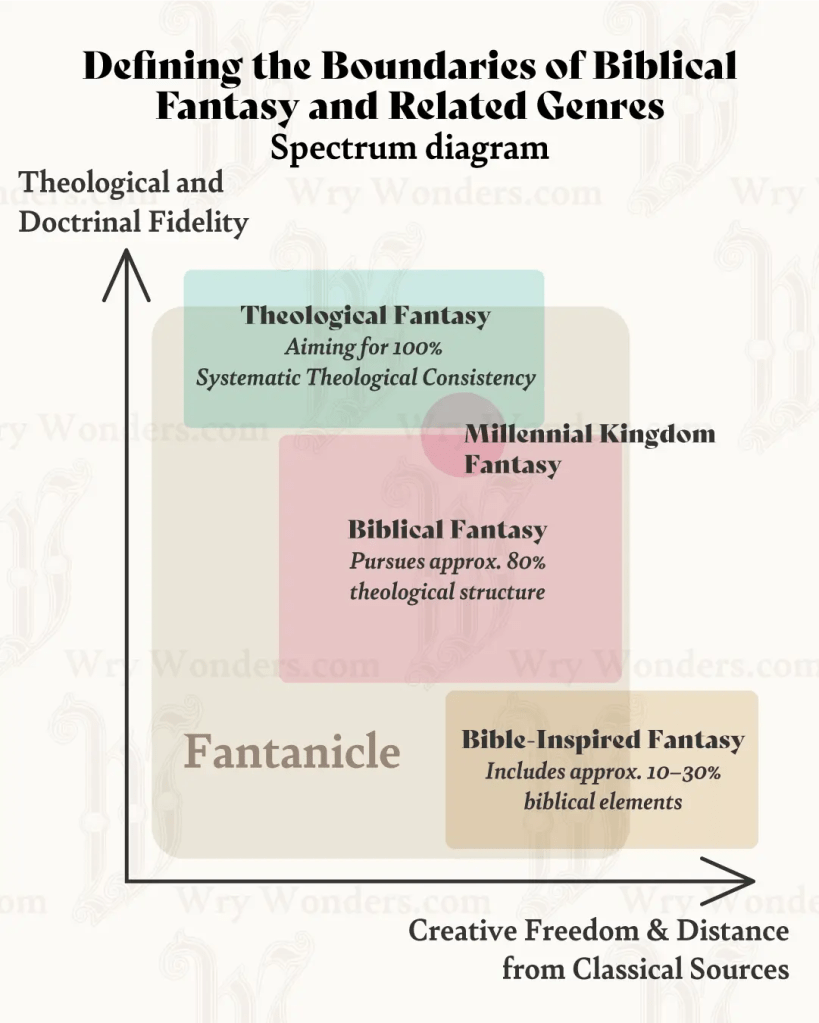
While Biblical Fantasy and Theological Fantasy are inherently based on Christian faith, Fantanicle does not limit its sources ideologically. A Fantanicle work may draw upon Dante’s Divine Comedy, Greek mythology, or even the Kojiki (Japan’s ancient chronicle) and still qualify.
- Biblical Fantasy qualifies as Fantanicle when it constructs a fantasy world that extends the worldview and values of the Bible as a classical text.
- Bible-Inspired Fantasy may fall under Fantanicle if its engagement with biblical motifs is deep and structured, but more loosely interpreted works may instead align with conventional fantasy or light novels.
- Theological Fantasy, too, qualifies as Fantanicle by virtue of its reliance on Scripture as a classical source. However, because it pursues systematic theological rigor, it also operates as a genre in its own right—one that reflects theological reflection within a creative narrative.
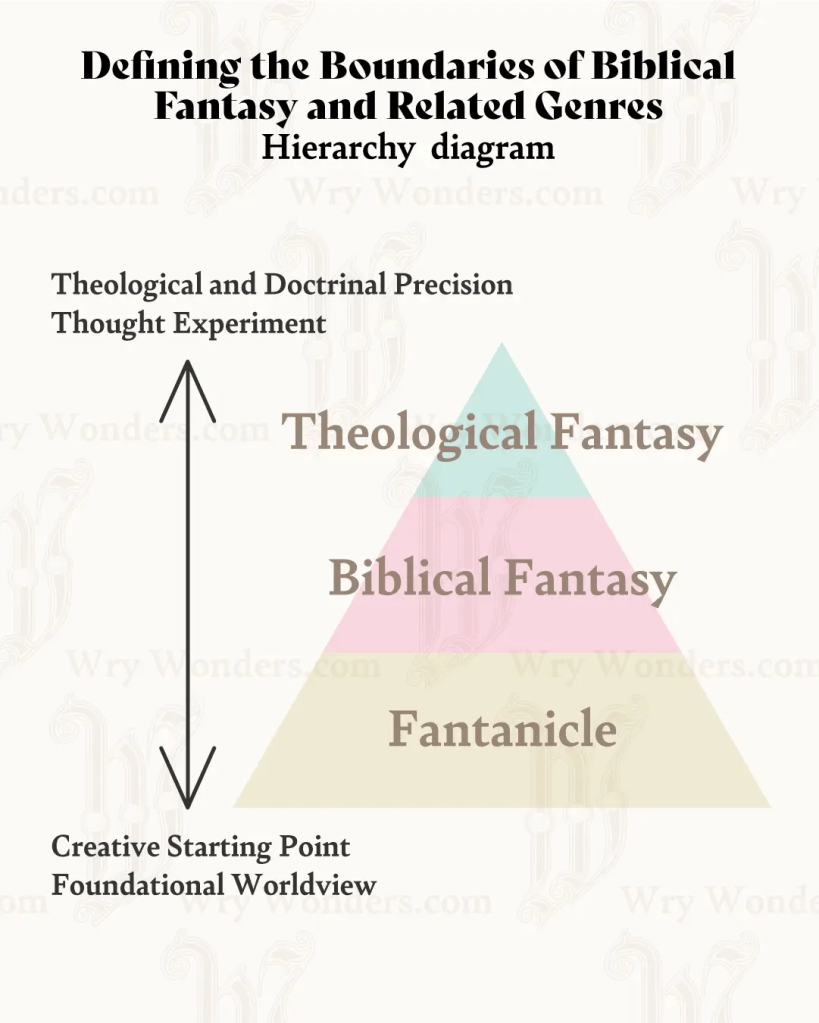
Relationship Between Theological Fantasy, Biblical Fantasy, and Millennial Kingdom Fantasy
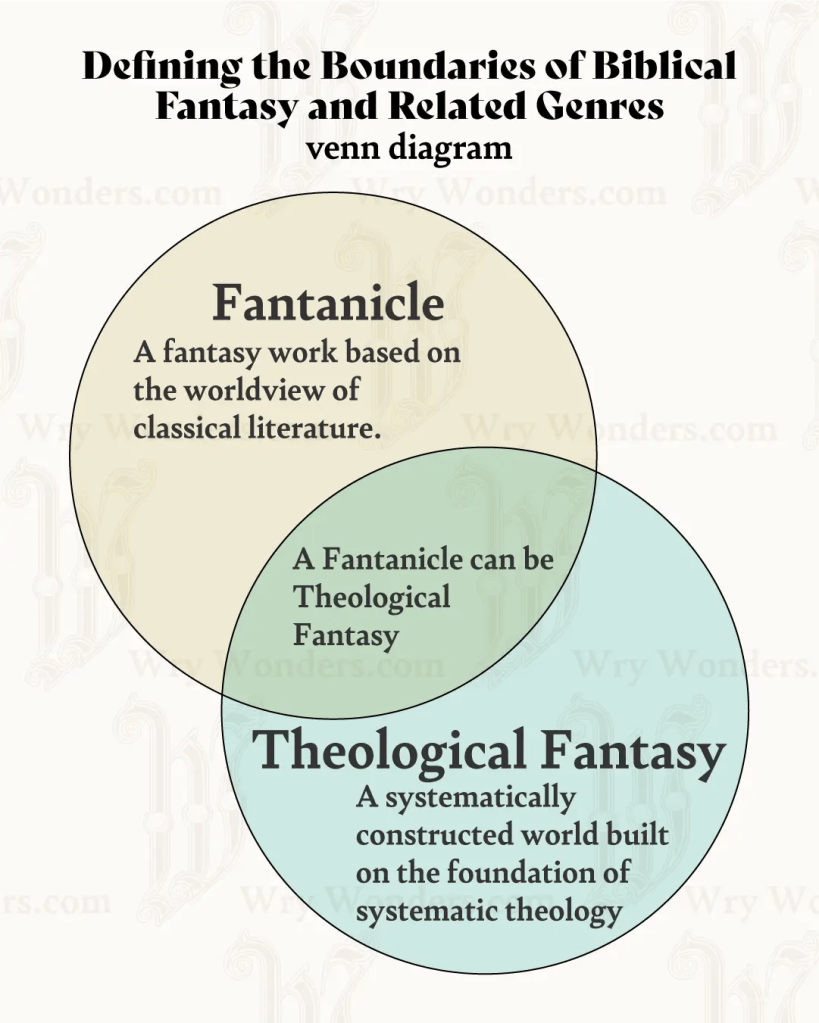
Millennial Kingdom Fantasy is a genre based on a literal interpretation of Revelation 20—where the resurrected Christ rules with His saints for a thousand years on earth.
It is not defined by Christian motifs, aesthetic grandeur, or mythic flavor alone, but by its grounding in Millennial Kingdom theology, structure, spirituality, and eschatological vision.
(Adapted from the Wry Wonders definition of Millennial Kingdom Fantasy (ja.))
- Broadly speaking, Millennial Kingdom Fantasy is a subgenre of Biblical Fantasy.
However, if the work adheres to rigorous theological structure and doctrinal interpretation of Revelation 20, it may belong to the higher-order genre of Theological Fantasy.
Disclaimer
This English translation was generated with the assistance of AI. While every effort has been made to preserve the original tone and meaning, some nuances may differ from the Japanese source. For the most accurate understanding, please refer to the original Japanese text.

Sister site
Wry Wonders is a space that illuminates the future
through both theology and storytelling, with the Millennial Kingdom as its guiding vision.
https://wrywonders.com/en/top-page/

 聖書ファンタジー講座
「聖書ファンタジー」とは何か?神学ファンタジーや信仰系フィクションとの違いを徹底解説。 – 聖書ファンタジー講座 への返信 コメントをキャンセル