Introduction: Clarifying the Premises Before the Journey
Contents
For the genre of “Bible Fantasy” to be established, we must first have a shared understanding of the Bible itself as a starting point. In this series, we will review:
- The basics of the Bible
- How to approach it
- The significance of Bible Fantasy
- Facing the possibility of error
Over three installments, we’ll review basic information about the Bible, the mindset for approaching it, and the significance and meaning of “Bible Fantasy” as a form of expression.
Finally, we’ll consider how to respond to the fear of making mistakes when dealing with the Bible and how to prepare ourselves for the worst-case scenarios.
This article is meant to be like a data book about the Bible — you don’t have to memorize it all at once, but it’s worth bookmarking for future reference.
Basic Information about the Bible
The Bible is not a single book, but a collection of texts compiled over a long period. In the Protestant Bible, it contains 66 books (39 Old Testament, 27 New Testament). The Catholic Bible has 46 Old Testament books, and the Orthodox Bible includes a few more, totaling 73 or more.
The Old Testament was composed roughly between the late second millennium BCE and the fifth century BCE, mainly in Hebrew and Aramaic. The New Testament was composed in the first century CE (around 50–100 CE).
Its authors comprise roughly 40 people, ranging from kings, priests, prophets, and scribes to fishermen and physicians. The texts are varied:
- Law (e.g., Exodus)
- History (e.g., Kings, Samuel)
- Prophecy (e.g., Isaiah, Jeremiah)
- Poetry and Wisdom Literature (e.g., Psalms, Proverbs, Job)
- Gospels (e.g., Matthew, Mark)
- Epistles (e.g., Romans)
- Apocalyptic Literature (e.g., Daniel, Revelation)
Many texts also combine multiple literary styles.
The Formation of the Canon
The Canon is a list of sacred, authoritative texts. Its establishment was not instantaneous, but the result of long reflection within Jewish and Christian communities.
Formation of the Old Testament
The Hebrew Bible (Tanakh) was largely settled by roughly the second century BCE (24 books, equivalent in content to the Protestant 39), and its boundaries became largely fixed within Jewish communities by the late first–second century CE. The discussions at Yavneh (around 90 CE) were about controversies surrounding certain books (e.g., Ecclesiastes, Song of Songs) and weren’t about formal canonization.
Meanwhile, the Septuagint (LXX) was translated from Hebrew into Greek between the third and first centuries BCE in Alexandria, and included later Jewish works (e.g., Tobit, Judith). The LXX became the foundation for the Christian Old Testament and the basis for the Catholic and Orthodox “deuterocanonical” books. Meanwhile, the Protestants adhered to the Hebrew text alone.
Formation of the New Testament
The 27 books of the New Testament were also shaped over several centuries:
- Late 1st century: The Gospels, Acts, and Pauline epistles were composed.
- 2nd century: Marcion’s creation of a limited “canon” sparked the Church to formalize its own.
- 3rd century: Growing acceptance of Hebrews, James, and other contested texts.
- 4th century: Athanasius of Alexandria’s Easter Letter (367 CE) identified the 27-book New Testament. Ratification came at the Councils of Rome, Hippo, and Carthage.
- 5th century: Eastern and Western churches came to consensus on the New Testament canon.
Criteria for Canonization:
- Apostolicity: Authorship by an apostle or someone closely associated.
- Orthodoxy: Consistency with the “rule of faith” (orthodox teaching).
- Catholicity: Universal acceptance across church communities.
Differences between Protestant, Catholic, and Orthodox canons arise mainly from the Old Testament books, reaffirmed during the 16th-century Reformation.
Translations and Textual Transmission
Throughout history, biblical texts have been translated into many languages, influencing countless cultures and literatures.
- Septuagint (LXX): Created between the 3rd and 2nd centuries BCE in Alexandria, making Hebrew scripture available in Greek. The New Testament quotes it extensively, making it the foundation of early Church theology and liturgy.
- Vulgate: Created by Jerome between the late 4th and early 5th centuries from Hebrew and Greek. It shaped Catholic liturgy and inspired countless works of medieval theology, literature, art, and architecture for over a millennium.
- King James Version (KJV): Created in 1611 by 54 scholars under King James I. Its majestic early modern English shaped English-language literature and became the de facto Bible for Protestants for centuries.
- Luther Bible (1522–1534): Created by Martin Luther, it shaped the German language and inspired the printing revolution, making the Bible available to ordinary readers and cementing its role as a classic text.
The Significance of the Bible Today
- The World’s Best-selling Book: An estimated 5 billion copies have been published (in whole or in part), making the Bible the best-selling book in history.
- Literature, Politics, Philosophy, and Popular Culture: Works such as Dante’s Divine Comedy, Milton’s Paradise Lost, and Steinbeck’s East of Eden draw directly from the Bible. Figures like Martin Luther King Jr.grounded their speeches and activism in biblical ideas.
- Most Frequently Quoted Text: Expressions like “The Good Samaritan,” “David versus Goliath,” or “falling scales from the eyes” have entered everyday language across the globe.
- Paradox of Influence vs. Readership: Despite being the best-selling book, many own a Bible but have rarely read it. According to a U.S. survey, about 90% of households own a Bible, yet roughly half of people have never read it thoroughly. This paradox reflects its deep cultural resonance despite low direct engagement.
- Use in NLP and AI: The Bible, as a public-domain text, is used extensively in Natural Language Processingresearch, advancing fields like comparative religious studies and text analysis.
Conclusion
The Bible is far more than a book of faith. Its texts, shaped across millennia, have influenced language, literature, philosophy, law, politics, art, pop culture, and even technology. Understanding its composition, canonization, and translation allows readers to rediscover its role in shaping the shared ideas, tensions, and common ground of the modern world.
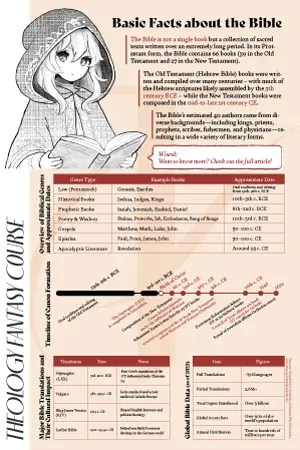
Download the visual summary in PDF
Disclaimer
This English translation was generated with the assistance of AI. While every effort has been made to preserve the original tone and meaning, some nuances may differ from the Japanese source. For the most accurate understanding, please refer to the original Japanese text.

Sister site
Wry Wonders is a space that illuminates the future
through both theology and storytelling, with the Millennial Kingdom as its guiding vision.
https://wrywonders.com/en/top-page/
 聖書ファンタジー講座
コメントを残す