
Basic Rules for Engaging with the Bible
目次 Contents
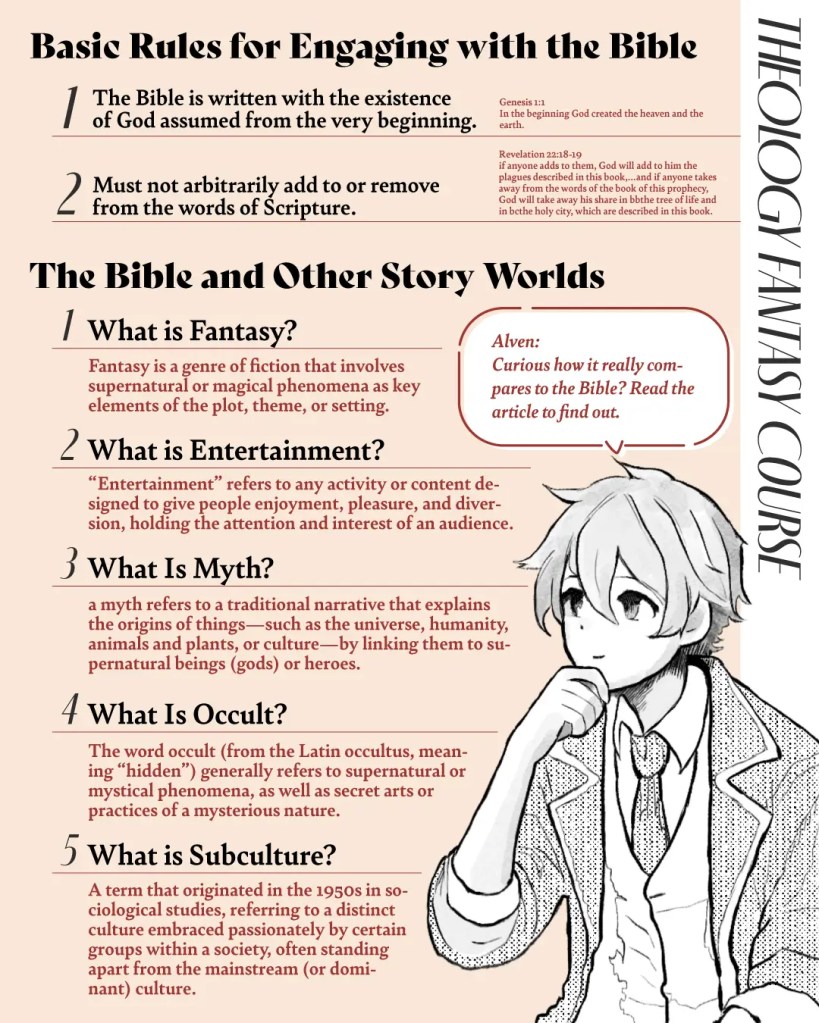
When reading the Bible, there are some fundamental “ground rules” to keep in mind. First, the Bible is written with the existence of God assumed from the very beginning. In fact, the opening verse of Genesis states, “In the beginning God created the heavens and the earth”, and it does not start by debating whether God exists or not. The human authors of the Bible wrote with an unwavering conviction that God is real, so within the biblical narrative world, God’s existence is a non-negotiable starting point.
The second basic rule is that one must not arbitrarily add to or remove from the words of Scripture. In the final chapter of the New Testament (Revelation), there is a solemn warning: “If anyone adds to them, God will add to him the plagues described in this book. And if anyone takes away from the words of the book of this prophecy, God will take away his share in the tree of life and in the holy city…”. This passage underscores that the Bible is a complete revelation given by God, and humans are strictly forbidden from rewriting or altering its content.
These two points—“read with God’s existence as a given” and “do not tamper with the text”—constitute the basic etiquette for handling the Bible. They are like the “rules of the game” or the mindset a reader must accept before entering the story world of Scripture.
The Bible and Other Story Worlds
Explaining “what the Bible is” can be challenging in a Japanese cultural context. Before defining what we mean by “Theological Fantasy,” it’s helpful to compare the Bible’s worldview with five other types of storytelling or cultural genres that people might confuse with it. By distinguishing the Bible from these, we can clarify what Theological Fantasy entails.
We will compare the Bible’s story world to the following five areas:
- Fantasy
- Entertainment
- Myth
- Occult
- Subculture
1. What is Fantasy?
First of all, what is “fantasy”? In general, fantasy is a genre of fiction that involves supernatural or magical phenomena as key elements of the plot, theme, or setting. These are stories where wondrous, impossible events—fairy-tale magic, dragons, elves, etc.—occur as a matter of course. Representative examples might include J.R.R. Tolkien’s The Lord of the Rings or C.S. Lewis’s The Chronicles of Narnia. In Japan, one might think of the Harry Potter series or Studio Ghibli’s Howl’s Moving Castle. In fantasy works, the author builds an imaginary world and sets up unrealistic elements like magic to function with internal consistency and no contradictions. The audience temporarily accepts the rules of that fictional world (the classic “suspension of disbelief”) in order to enjoy the story, and from it they may draw insights or emotional experiences applicable to reality.
By contrast with these features, the Bible is not a fantasy. Yes, the Bible contains stories of miraculous events—a sea parting (in Exodus), the dead being raised (in the Gospels)—which at first glance might seem “fantastical.” However, the miracles described in the Bible are presented not as fictional magic for entertainment, but as real acts of God that actually happened. The biblical writers are not saying “Here is a made-up tale of magic,” but rather testifying, “This is something God truly did in history.” Moreover, whereas a fantasy world’s creator is the human author, the “world” of the Bible has God Himself as Creator. In the Bible’s narrative, God (the author) created and sovereignly rules the real world – a decisive difference from fantasy. In short, fantasy is an “imaginary world” born of human imagination, whereas the Bible is a book that records the fundamental truth of the real world as revealed by God.
To summarize the key points:
- Fantasy: A story set in a fictional world created by human imagination. It features magic or supernatural phenomena depicted as part of the story’s internal rules and make-believe universe. The reader knows it’s fiction and enjoys it as such.
- The Bible: A book that records the reality of God’s existence and miracles. It also contains supernatural events, but these are described as works of God that truly occurred. Readers (believers) receive them as truth and seek divine revelation through them.
The Bible’s worldview is as grand in scope as any epic fantasy, but its nature is fundamentally different from fantasy.
2. What is Entertainment?
Next, what is “entertainment”? “Entertainment” refers to any activity or content designed to give people enjoyment, pleasure, and diversion, holding the attention and interest of an audience. This covers a broad range of popular amusements: movies, music, theater, TV shows, comics and anime, novels, video games, sports spectating, and so on. The basic purpose of entertainment is “to entertain” – to make people forget everyday stress or boredom and provide emotional satisfaction or excitement.
In the literary world, when we speak of “entertainment” fiction, we mean popular, accessible novels geared toward enjoyment, as opposed to dense highbrow literature or purely educational works. Such entertainment novels (通俗小説) are written to appeal to the general public’s taste and are highly entertaining, without placing emphasis on artistic profundity. For example, mystery thrillers, adventure tales, or romance dramas would be considered “entertainment fiction” enjoyed by the masses. These works aim primarily to thrill, amuse, or move readers to tears, and the audience can simply enjoy the storyline for fun.
Is the Bible an entertainment piece? In a word, no – the Bible is not a work of entertainment. To be sure, the Bible contains dramatic narratives and poetic passages that can grip the heart. However, its intent is not mere “amusement” or “distraction.” The central purpose of Scripture is to reveal truths about God’s relationship with humanity, the way of salvation, and guidance for life – not to provide momentary escapism or pleasure.
For example, the Old Testament stories are sweeping and even exciting as historical epics, but they were written to convey the history of Israel and its covenant with God. Similarly, the New Testament Gospels are moving narratives of Jesus Christ’s life, but they serve as the record of the Good News of human salvation. Readers are expected to draw revelation and life lessons from these writings, not just say “Well, that was entertaining” and leave it at that.
In essence, while the Bible can be engaging to read, it is fundamentally a book of divine revelation and stands apart from commercial works of entertainment created to entertain audiences for profit. Treating the Bible like just another entertaining novel – approaching it with an attitude of “as long as it’s enjoyable, that’s all that matters” – would mean missing its profound message. Conversely, the Bible possesses value far beyond mere entertainment; it even holds the power to transform one’s outlook on life.
3. What Is Myth?
First, what exactly is a “myth”? In the original sense, a myth refers to a traditional narrative that explains the origins of things—such as the universe, humanity, animals and plants, or culture—by linking them to supernatural beings (gods) or heroes. For example, Greek mythology explains the origin of the seasons through the story of the goddess Demeter and her daughter Persephone, and Japanese mythology (as in the Kojiki) recounts the creation of the land and the genealogies of the gods. Every culture has its own mythological system, and each of these systems reflects that culture’s worldview.
These myths are held as sacred within their cultures and have been passed down as stories that reveal how the world came to be and the order of the cosmos. They are believed by the people as “a sacred narrative revealing absolute truth” about the world’s origins and order, accepted without question. In short, “a myth is a tale of origin that the people of a culture believe to be true without a shred of doubt.” On the other hand, in modern usage “○○ myth” can also mean “something that many people have believed for years without any basis in fact”. For instance, phrases like “economic growth myth” or “undefeated myth” refer to things that people are convinced of despite a lack of proof. In this sense, “myth” carries the nuance of a widely believed rumor or popular notion that is likely false.
Now, is the Bible a myth? That’s a rather tricky question. Some people argue that the stories in the Book of Genesis—like Adam and Eve or Noah’s Ark—are nothing more than myths similar to other cultures’ creation myths. In academic contexts as well, biblical narratives are sometimes analyzed as part of ancient Israel’s mythological framework. However, from the standpoint of Christian faith, the Bible is certainly not “just a myth.” The Bible does indeed tell of the origin of the world (Creation) and the beginnings of humankind, but it conveys these events as historical facts and as God’s revelation. In other words, even if the Bible’s narratives take on a mythic form, for believers they are literally true and an absolute, sacred revelation of God’s truth At first glance this may seem similar to how a myth is revered as a “true story” within its culture, but there is an important difference. The difference is that the God of the Bible is the one and only absolute true God, and His revelation is claimed to be universal to all humankind, beyond any one culture’s confines. Whereas many myths are polytheistic or limited to a particular people, the Bible depicts a single God who creates the entire universe and unfolds a plan of salvation, presenting it as truth for all people across every nation and race.
Therefore, from the Christian perspective, the Bible’s narratives are not “human-made myths” but revelation — that is, the truth of salvation given by God, containing no product of human imagination. In fact, it has been pointed out that the very inclusion of often tedious genealogies and historical records in the Bible is strong evidence that it is not an invented tale but a fact-based historical account. To summarize the distinction:
- Myth (general): A traditional story of gods or heroes passed down within a culture to symbolically explain the origin of the world or natural phenomena. It is accepted by the people of that culture as an unquestionable, sacred truth about how the world is ordered. (From an outside perspective, such stories are often regarded as legend, allegory, or folklore rather than factual history.)
- The Bible: A collection of writings in the Judeo-Christian tradition narrating the story of God and humanity, from the creation of the world to the ultimate salvation. However, for believers this is not merely a cultural mythology but the true history of the world and a universal revelation from the one true God. Parts of it may appear mythic or fantastical to non-believers, but within the faith it is regarded as literal fact and divine truth.
4. What Is Occult?
Next, what do we mean by “occult”? The word occult (from the Latin occultus, meaning “hidden”) generally refers to supernatural or mystical phenomena, as well as secret arts or practices of a mysterious nature. Ghosts and the spirit realm, fortune-telling and magic, psychic powers, clairvoyance and other paranormal occurrences, UFOs, and so on — all of these fall under what people commonly call “the occult.” It can also refer to arcane knowledge or magical arts that are hidden and known only to a select few. In Japan especially, within pop culture, “occult” topics are popular in magazines and TV programs featuring ghost photographs or bizarre phenomena, and they are often discussed as an extension of horror movies or urban legends. There have been several “occult boom” periods since the 1970s, during which public fascination with fortunetelling, supernatural powers, and other paranormal topics surged. Generally, having an “interest in the occult” means one is curious about mysterious phenomena or spiritual curiosities.
So, does the Bible have anything to do with the occult? At first glance, one might wonder if the Bible is an occult book, since it too contains miracles, prophecies, angels, and evil spirits — all of which are supernatural occurrences. However, the conclusion is that the Bible itself is not occult at all; in fact, the Bible explicitly forbids occult practices. Throughout Scripture God repeatedly warns against engaging in things like divination, sorcery, or spiritism, condemning them as detestable acts (for example, see Deuteronomy 18:10–12, Leviticus 19:31). Indeed, “the Bible clearly forbids all contact with the occult”. In the biblical worldview, supernatural beings (spiritual entities) certainly appear, but they are either servants of God (angels) or evil beings in rebellion against God (demons), and humans are told not to meddle with them. In other words, the supernatural realm in the Bible is placed strictly under God’s authority and order; it’s not a domain of “occult power” that people can secretly tap into or control by their own will.
On the other hand, you might have heard the saying that “the basics of the occult are in the Bible.” This is a claim sometimes made in popular lore. It is true that Western occult thought over the centuries has incorporated certain religious elements derived from the Bible.
For example, Kabbalah, which is a form of Jewish mysticism, and early Christian Gnosticism (esoteric teachings considered heretical by the Church) have been absorbed into occult traditions. Medieval and early-modern Western magic (occultism) had the Hebrew Kabbalah at its core, and many modern occult prophecies, apocalyptic theories, and conspiracy theories have been formulated with biblical knowledge as their premise.
The Book of Revelation (「ヨハネ黙示録」 in Japanese) and the prophetic visions in the Book of Ezekiel, which are part of the Bible, are full of rich symbols that at first glance might seem “occult-ish” in nature. These aspects have led some to assert that the Bible is the source of the occult.
However, it is important to understand that those biblical elements were originally written as part of religious revelation, not as instructions for occult practice. The fact is, the term “occult” itself did not appear until the mid-16th century in Europe, and the roots of occult beliefs and practices go much further back — tracing to the astrology of ancient Egypt and Mesopotamia, the Hebrew Kabbalah, the secret teachings of Pythagorean sects in ancient Greece, etc.. From antiquity up to modern times, the lineage of occultism was carried on in secrecy, often through esoteric societies and orders; even in the modern occult revival, countless secret brotherhoods like the Rosicrucians and Freemasons sprang up to clandestinely pass on occult rites and knowledge.
In short, the Bible itself is not an occult text — rather, it is later generations of people who have reinterpreted or used parts of the Bible in occult ways. The Bible is not a handbook of occult tricks; on the contrary, it is a scripture that warns against getting involved in occultism. When approaching the Bible, one should do so with a sincere heart to receive the message from the Creator, rather than diving into it looking for supernatural phenomena or secret powers out of curiosity.
5. What is Subculture?
Finally, what do we mean by “subculture”? Subculture (or sabukaruchā in Japanese) is a term that originated in the 1950s in sociological studies, referring to a distinct culture embraced passionately by certain groups within a society, often standing apart from the mainstream (or dominant) culture . Literally, it means a “subordinate” or “secondary” culture. In Japan, it has come to describe a range of interests associated with popular or niche culture — anime, manga, video games, idols, visual kei music, underground films, and other interests often embraced by “otaku” communities. To call someone a “subculture fan” can imply that the person is deeply engaged in these niche interests, making them distinct from the mainstream.
In short, subculture is a minority-driven, often unconventional, and sometimes misunderstood sphere of culture. To mainstream audiences, it can seem strange or obscure, yet it is precisely this quality that allows subcultures to foster unique and experimental expressions that can later evolve to influence the mainstream. For example, anime and video games, once considered “subcultural,” are now celebrated internationally and have become a vital part of Japan’s mainstream culture.
So, is the Bible a subculture? In the context of Japanese society, where the number of Christians is small and biblical literacy is limited, one might be tempted to categorize the Bible and the culture surrounding it as a sort of subculture. Indeed, for many in Japan, attending church or exploring the Bible may seem like a niche hobby, akin to other subcultural interests. At a glance, biblical literature may be treated as an obscure or esoteric area of interest.
However, from a historical and global perspective, the Bible is far from a subculture. In reality, the Bible has long served as the spiritual and intellectual foundation of Western civilization. Its influence can be traced across countless fields — music, literature, fine arts, education, law, and political thought — making it a cornerstone of the mainstream culture in the West for centuries.
That said, in Japan, where Christians remain a religious minority, the Bible can occupy a de facto subcultural position. At the bookstore, you might find only a tiny section dedicated to biblical studies, making it seem obscure or irrelevant to the average visitor. Moreover, certain books about the Bible are presented with an occult or subcultural flavor — focusing on apocalyptic prophecies or urban legends — creating the mistaken impression that the Bible itself is an “occult” or “fringe” text.
But let us be absolutely clear: the Bible itself is far from being a subcultural artifact. It is the pinnacle of the classical canon, a book that has shaped human thought and culture across millennia. Its timeless nature places it beyond the realm of niche interests or fleeting trends. What we have in the Bible is not a piece of obscure or ephemeral subculture, but a universal classic that has influenced countless generations across borders and eras.
Readers of this Theological Fantasy Course may well include aspiring creators and writers with a “subcultural” sensibility — people with a deep love for storytelling, a fascination with mythology, and an ear for overlooked narratives. This is a beautiful thing. However, as you engage with the Bible and truly grapple with its sheer scale and profound depth, you will find it is not merely another piece of obscure subcultural trivia. The Bible is a core text that can upend your worldview and reshape your creative and spiritual life. That is precisely what makes it unique.
Conclusion: The Bible is Not Fantasy, Entertainment, Myth, Occult, or Subculture — It Is a True Story
As we have explored throughout this series, the Bible is unlike any other book. It is neither a work of fantasy, nor a piece of entertainment, nor a myth, nor an occult manual, nor a subcultural artifact. The Bible occupies its own unique space — a category beyond comparison.
The Bible contains moments that can captivate like a fantasy, moments that entertain with profound narratives, moments that seem to shimmer with the allure of myth, and moments that hint at the unseen spiritual realm. Yet none of these elements diminish its core reality: the Bible is a witness to historical and eternal truth, a truth that separates it from every human invention and fiction.
Then why, in this series, have we used the term “Theological Fantasy”? The intention is to borrow the power of the fantasy lens — its rich, captivating imagery and its ability to draw readers deep into a narrative — as a way to illuminate the completeness and infallibility of the biblical worldview. In many ways, the Bible can be said to have a narrative depth and coherence that no human-constructed fantasy can rival. From Genesis to Revelation, it unfolds an internally consistent, captivating, and expansive story — one that speaks to the depths of the human heart and the heights of eternity. In this sense, it is the ultimate ‘story’ of reality.
We can never write the Bible as a fantasy work ourselves, but through the lens of fantasy, we can approach its breadth and richness, gaining fresh insights and a deeper sense of its significance. This is where writers and creators can draw unlimited inspiration — where the threads of biblical truth can become the warp and weft of new stories, new worlds, and new ideas.
The legacy of writers like C.S. Lewis and J.R.R. Tolkien proves that biblical truths can be reframed within the contours of fantasy, making profound spiritual realities accessible to readers across time and culture. These writers used the language of myth and fairy tale to whisper truths about sacrifice, redemption, and eternity — truths rooted in the biblical witness.
To summarize, the Bible is the story that gives birth to all stories. It is a book that enthralls like fantasy, moves like entertainment, shines with the depth of myth, stands opposed to the darkness of the occult, and transcends the boundaries of subculture. It is a universal classic and an eternal voice that still speaks — challenging preconceptions, reshaping hearts, and drawing readers into a world far deeper than the one they inhabit.
Through this Theological Fantasy Course, we invite you to rediscover the Bible as it truly is: God’s gift of a True Story — a sacred, timeless, and infinitely compelling narrative. Let go of your preconceptions, step across the threshold, and enter its world. What you will find is a journey beyond mere imagination — a journey towards the heart of ultimate reality. Somewhere beyond the veil of skepticism, cynicism, and superficial trend lies a truth that shines brighter than any fantasy, a voice that still whispers to every seeking heart. Will you listen? Will you step into the story? The adventure of a lifetime — and beyond — is waiting for you.
Disclaimer
This English translation was generated with the assistance of AI. While every effort has been made to preserve the original tone and meaning, some nuances may differ from the Japanese source. For the most accurate understanding, please refer to the original Japanese text.

Sister site
Wry Wonders is a space that illuminates the future
through both theology and storytelling, with the Millennial Kingdom as its guiding vision.
https://wrywonders.com/en/top-page/

 聖書ファンタジー講座
『聖書ファンタジー』とは? 聖書がファンタジー・神話・サブカルと一線を画す理由(The Bible vs. Fantasy, Myth, and Subculture: Understanding Theological Fantasy) – 聖書ファンタジー講座 への返信 コメントをキャンセル